
Monthly Summary

March 2026 Avalanche Summary – Colorado

March 2026 marked a sharp transition from late-winter persistent slab and wind slab concerns to a predominantly wet-snow avalanche pattern during an extended warm period. Early March still produced large avalanches on buried weak layers (including a fatal accident near Vail Pass), while mid- to late March brought record-warm temperatures and widespread wet loose and wet slab cycles.

Map of Colorado showing snow water equivalent as a percent of the 1991–2020 median on March 31, 2026. Most of the state is well below average, with many basins ranging from about 9% to 38% of normal, indicating significant snowpack loss after a prolonged warm period.
Snow water equivalent across Colorado on March 31, 2026, shows well below-average snowpack statewide following an extended period of record warmth. Many basins are at 10–35% of normal, highlighting the rapid loss of snow during the March heat wave.

Statewide Avalanche Activity (March 2026) 

  • 552 avalanches recorded across the state
  • 4 avalanches size D3
  • 179 avalanches size D2 & D2.5
  • 369 avalanches size D1 & D1.5
  • 64 human-triggered avalanches
  • 5 people caught, 2 buried, 1 fatality
Charts showing avalanche activity in Colorado for March 2026, with the highest counts in the Gunnison area and peaks in activity in early March and during the late-March warm period.
Avalanche activity in Colorado during March 2026 by region and date, showing the highest number of avalanches in the Gunnison zone and peaks in activity during early March and again during the mid- to late-March warm period.

Early March

In March, Colorado’s first avalanche fatality of the 2025–26 season occurred in the Northern Mountains. On March 7, a solo backcountry skier triggered an avalanche in Boss Basin (Resolution Creek area near Vail Pass). The hard slab released on a buried weak layer, stepped down to the ground, and pulled out the entire season’s snowpack. 
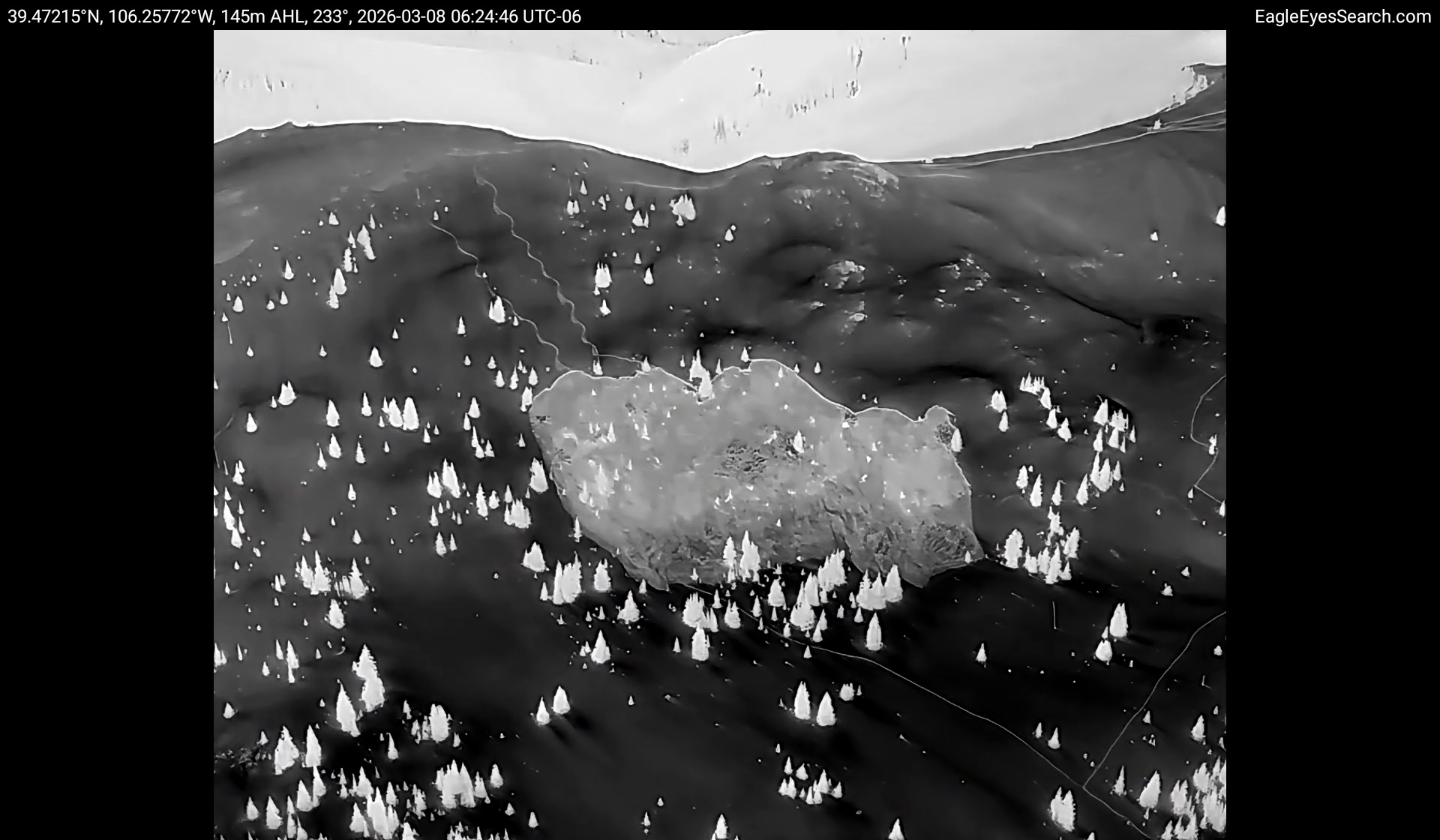
Thermal aerial image of an avalanche near Vail Pass, Colorado, showing the debris field from the March 7, 2026 fatal avalanche.
Thermal image of the March 7, 2026 avalanche near Vail Pass, captured by an unmanned aircraft system during the response. The image shows the full extent of the debris field from the persistent slab avalanche involved in the fatal accident, as well as two ski tracks entering the avalanche path and only one exiting. (Image courtesy Summit County Rescue Group)

In the Central Mountains, warm weather in some areas brought rain and meltwater into the snowpack, while persistent slab avalanches continued to be triggered by backcountry riders on steep, colder upper-elevation aspects. Avalanche activity in the Central Mountains spiked from March 6–8, when a small storm produced a notable avalanche cycle with multiple large to very large avalanches. Conditions during this period featured low-probability, high-consequence persistent slab avalanches, with limited obvious warning signs and the potential to trigger avalanches from a distance. The Southern Mountains saw fewer and generally smaller avalanches.

Mid-March

Mid-month conditions were characterized by frequent small storms and strong winds. In the Northern Mountains, Front Range areas picked up 10-18 inches of snow, while winds were strong enough to rapidly build fresh drifts near and above treeline. In the Central and Southern Mountains, mild temperatures and strong northwest winds continued to decimate the snowpack and produce wet avalanches, while some wind-affected slopes remained prone to dry slab avalanches.

This period marked a notable shift toward wet avalanche problems earlier than typical, while some shaded aspects still held lingering persistent slab potential.

Late March

From approximately March 18 onward, record-breaking heat drove a pronounced wet-snow cycle across Colorado. Widespread wet loose activity was reported statewide, and wet slab avalanches became more common, including some large (D2–D2.5), as warming continued and wet avalanche problems spread to more aspects. In the Northern and Central Mountains, it remained possible to trigger dry slab avalanches on steep, north-facing slopes, leaving conditions caught between midwinter and spring avalanche problems.

Travelers increasingly needed to start early and end early, and get off of steep slopes before the snow became wet and unsupportable, especially on east-, south-, and west-facing aspects. Late in the month, multiple consecutive nights without an overnight freeze made the window for finding firm, supportable snow — and avoiding wet avalanche problems — very short or nonexistent in some areas.

Cooler temperatures arrived around March 26, and heading into April the pattern began to shift back toward winter, with colder temperatures, strong winds, and snow in the forecast.

A fresh avalanche on a steep alpine slope in the Southern Mountains of Colorado, with debris spread across the lower slope below rocky terrain and trees. The avalanche occurred on March 7, 2026, at about 11,800 feet and was likely triggered by warming temperatures.
A wet-snow avalanche in the Southern Mountains on March 7, 2026, likely triggered by rising temperatures. The slide occurred on an upper-elevation slope around 11,800 feet and produced a D1.5–D2 avalanche.
(full)
A backcountry skier stands in avalanche debris on a snowy slope near Mosquito Creek in the Central Mountains, where two skiers were caught on March 8, 2026. One was partially buried to the hip, and both self-rescued without serious injuries
Avalanche debris east of Mosquito Peak near Mosquito Creek on March 8, 2026, after two backcountry skiers were caught when the slope released above them. One person was partially buried, but no one was seriously injured.
(full)
CAIC forecaster stands near a large avalanche crown on a steep, snow-covered slope near Vail Pass, Colorado. The fracture line shows where the snowpack broke and released on March 7, 2026, when a skier triggered a persistent slab avalanche that stepped down to deeper layers.
Crown line from the March 7, 2026 avalanche near Vail Pass, where a solo backcountry skier triggered an avalanche in the Northern Mountains. The accident resulted in a fatality.
(full)
Large skier-triggered wet slab avalanche on an east-facing slope near Fremont Pass in the Central Mountains, on March 22, 2026.
A skier-triggered large wet slab avalanche on an east-facing slope near Fremont Pass on March 22, 2026, during the prolonged warm period that drove widespread wet-snow avalanche activity across Colorado.
(full)
Aerial view of a wet-snow avalanche near treeline in Gen X Bowl, East Vail, on March 20, 2026 during a warm period.
Wet-snow avalanche on an east-facing slope near treeline in Gen X Bowl, East Vail on March 20, 2026, during the extended warm period that produced widespread wet avalanche activity.
(full)